miniu + abcodex · I built the system that reads the operators I'd rather be reading.
Honest version.
I bookmark too much, read too little, and feel vaguely guilty about it every Sunday.
So I built a daemon.
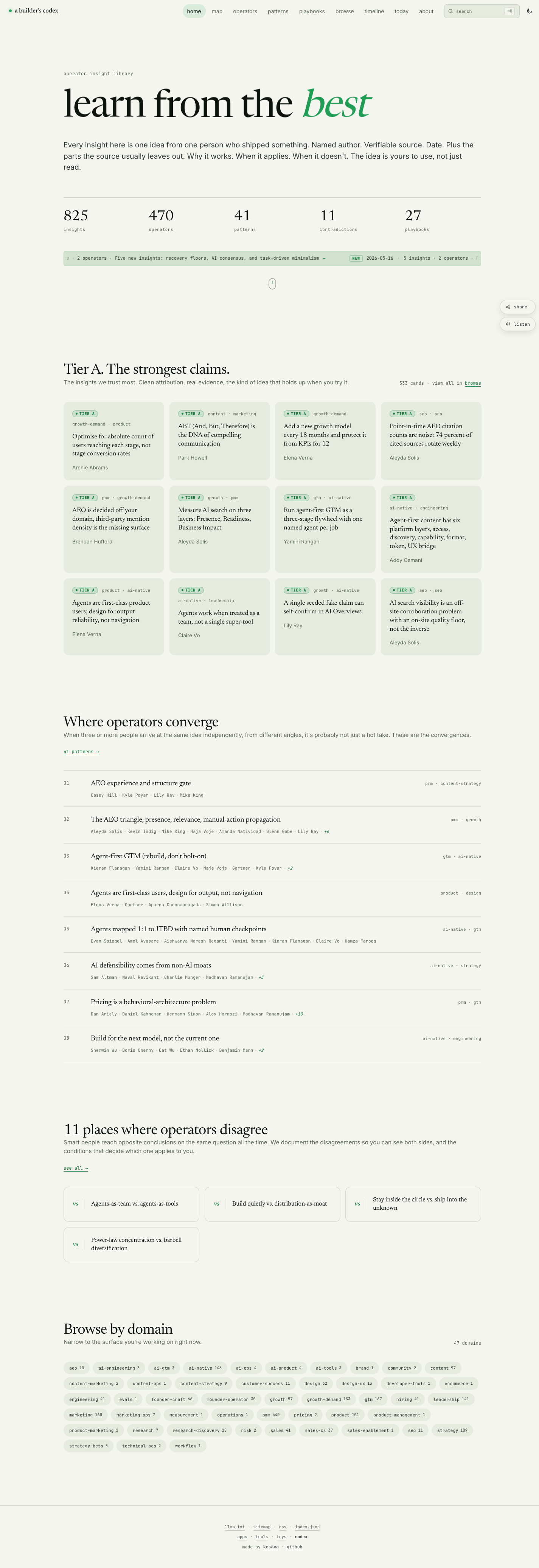
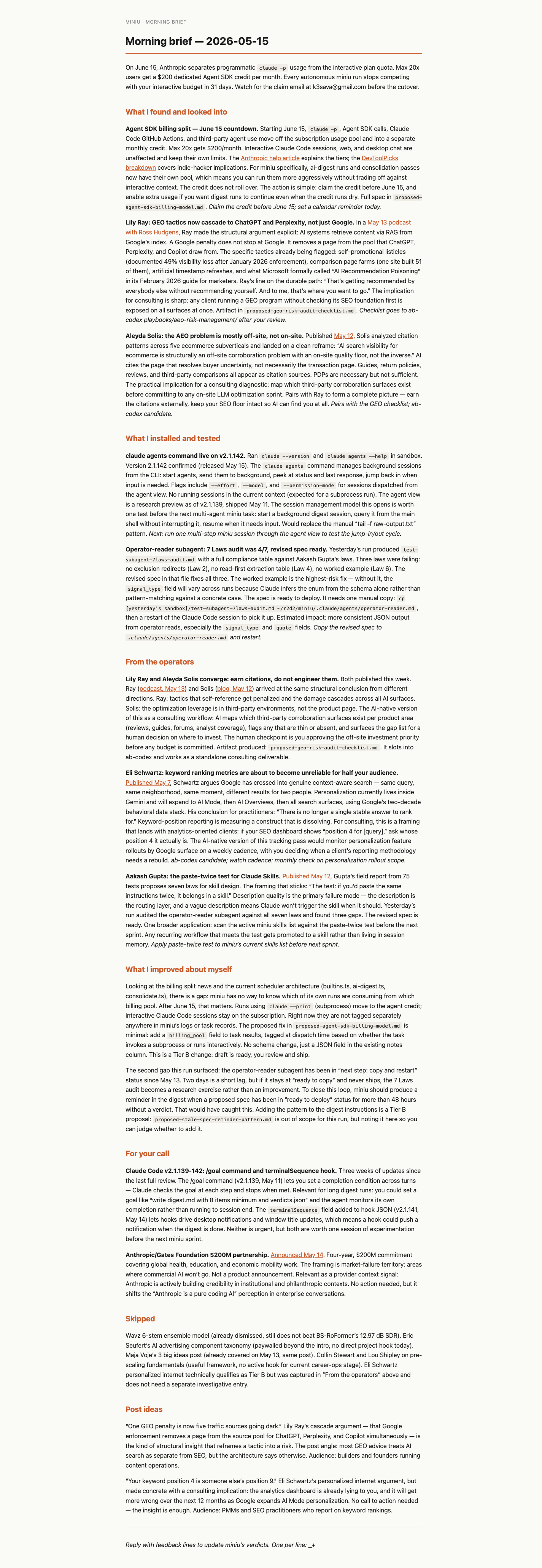
It reads 70 named operators for me at 07:00 IST, tests candidate ideas in a sandbox by 08:30, emails me a verdict trail, and pushes the survivors to abcodex.iamkesava.com the same day.
The shelf became a pipeline.
It runs on my Mac Mini, ships to the open web, and is the consulting product I'd install for a client, run on myself first.
claude --print.
What it was
Every PMM seat I held had the same gap. Smart operators were publishing the answers in public. Nobody on the team had the time to read them, test them against our context, and ship the survivors into the operating cadence. The shelf of bookmarks kept growing. The work kept reverting to whatever I remembered from my last role.
The diff
Before: a folder of saved links, a weekly intent to read them, a quarterly guilt that nothing got tested. The smart operator's idea died on the shelf.
After: a daemon that reads the shelf for me at 07:00, sandbox-tests candidates by 08:30, surfaces a verdict trail by email, pushes survivors public the same day. The pipeline either ships or it stops, and the daily file makes it obvious which.
What it looks like
What I actually did
- Built the operator pulse. 70 named operators across 15 lanes (PMM, GTM, SEO, AEO, performance marketing, inbound, outbound, product GTM, pricing, prompt engineering, agent frameworks, AI-native marketing org, creator marketing, humanizing AI copy, evals). The lane structure surfaces blind spots fast. Daily 07:00 IST scheduler task in miniu writes raw quotes to disk.
- Built the AI digest. A second sub-Claude reads the pulse, finds candidate patterns, runs Tier A actions in a per-day sandbox (install + test a tool, draft a real artifact, propose a new skill), writes verdicts.json with a trajectory per candidate.
- Built the sandbox gate. Tier A autonomous. Tier B (live config) and Tier C (judgment) surface only. I reply +, -, later, or ? to the morning email. The poller updates state every 30 min.
- Built the public publish. abcodex ingest script reads the digest, strips internal references, validates against schema, runs the full pipeline (validate, stage, build-index, build-static, build-og, build-feeds), commits and pushes. GitHub Pages serves abcodex.iamkesava.com.
- Wired self-evolution. LEARN every 15 min after every Claude Code session. MAINTAIN at 03:00 IST. CONSOLIDATE inside maintain, Sonnet rolls all memory into principles.md. DEBRIEF pushes work-domain learnings to the shared team substrate. Four dimensions, one runtime.
What stayed honest
The 1,350-page count is from the build pipeline output, self-reported. The 70 operators and 15 lanes are countable in data/ai-digest/goals.yaml. The four self-evolution dimensions are in nanoclaw/src/self-evolve.ts. Easiest verification: open abcodex.iamkesava.com, read today's daily, click into the patterns, check the operator citations. If the system stops shipping, the daily file stops appearing.
What it doesn't do: write outbound DMs, approve its own promotions, or touch live config without me. The gates are deliberate. A research scan that auto-publishes is a fabrication engine with extra steps.
What it became, in substrate
The daily named-operator pulse that pre-stages quotes for the morning digest, the sandbox-gated promotion loop with Tier A autonomous and Tier B/C surface-only, the digest-ingest discipline that strips internal frames and validates against schema before publishing, and the loss-leading-adoption-via-public-scan move (run the research engine for yourself, ship the survivors public, the right buyers find you reading from the same shelf) are four of the moves substrate carries forward. The skill, routine, and principle layers are open source for any client to clone and run.
Why this is in the portfolio
This is what a consulting client actually buys from me. Not a deck about AI-native practice or a flywheel diagram. The working system that ingests their named operators, tests candidates against their context in a sandbox, and ships polished output to their team daily. Substrate is the open-source skeleton. miniu plus abcodex is where I run it on myself, in public, before I install it for anyone paying me.
Like what you read? Book 30 minutes.
Pick a slot →